
Importing EV chargers as finished units makes it hard to meet the localization requirement for government-subsidized chargers. Supplying components (SKD) and assembling them in Korea is designed to support localization and government-spec requirements while KC certification is pursued. Here is what OHI Tech confirmed while supplying RongXin chargers via SKD plus local assembly.
Quick Answer: Why SKD Supply Is the Path to Subsidy-Eligible Chargers
Bringing in components (SKD) and assembling locally — rather than importing finished units — is designed to support localization and government subsidy charger standards. Final eligibility depends on KC certification and each subsidy program's criteria.
Importing finished units is disadvantaged for subsidies and leaves KC certification and after-sales dependent on overseas suppliers. SKD changes that structure.
What Is SKD? How It Differs from Importing Finished Units
SKD (Semi Knock Down) means receiving the charger as components and assembling it in Korea.
Instead of buying a finished unit, the enclosure, power module, controller, and other parts are imported and assembled and verified locally — which helps with localization recognition and certification.
| Item | Finished-unit Import | SKD + Local Assembly |
|---|---|---|
| Localization recognition | Difficult | Possible |
| Subsidy charger standard | Limited | Designed to support (cert in progress) |
| KC safety certification | Importer burden / delay | Pursued via local assembly |
| After-sales / lead time | Overseas-dependent | Domestic response |
| Part swap / customization | Limited | Adjustable per cert needs |
| Cost structure | Higher | Relatively lower |
Which Components Are Supplied as SKD?
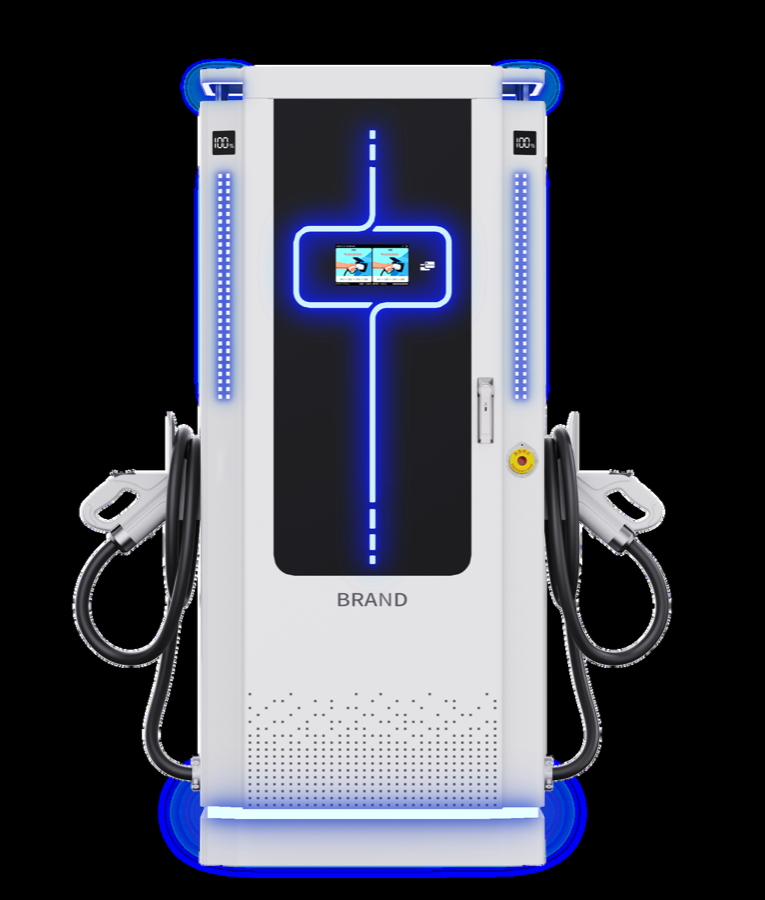
Both DC fast and AC chargers can be supplied as SKD, with the configuration adjusted to Korean local-assembly requirements.
Key supplied components include:
- Enclosure, power module, main controller board
- Energy meter, charging cable and connector, display
- RFID module, PLC module, wiring harness, cooling fan
- Contactor, residual current device (RCD), emergency-stop switch, filter, molded-case circuit breaker (MCCB)
How Are Government Specs Met?
The design is verified against the Korean Ministry's official guideline. Compliance by key item:
| Government Requirement | Status |
|---|---|
| EV–charger comms (DIN 70121 / ISO 15118) | Supported |
| Server comms OCPP 1.6+ | OCPP 1.6J (upgradeable to 2.0.1) |
| Efficiency / power factor (≥95% / ≥0.95) | Efficiency ≥95% (peak 96%), PF ≥0.99 (200kW) |
| Remote firmware update | OTA supported |
| Payment (card / RFID / QR / app) | Supported + Korean CMS, Korean UI |
How Far Along Is Certification?
CE is held. KC safety, high-efficiency, and OCPP certifications are pursued together with local assembly.
Core components can be adjusted or swapped per certification requirements, so the configuration can be matched to pass domestic testing.
What Support Does the Manufacturer Provide?
It does not stop at component supply. Assembly manuals and wiring diagrams are provided, along with remote technical support, online training, and commissioning.
Factory-based technical training is also available, securing stable local-assembly quality.
References
- Korea Ministry of Environment EV Portal — Charger Subsidy Programs
- KATS (Korean Agency for Technology and Standards) — KC Certification
FAQ
Q1. Does SKD assembly really count as localization? Importing components and performing substantial local assembly and verification helps meet localization requirements. We review detailed per-program subsidy criteria against the spec sheet in advance.
Q2. Can we adopt it before KC certification is complete? CE is held, and KC safety and high-efficiency certifications are pursued alongside local assembly. Core components are adjustable per cert requirements, so we proceed on the basis of passing domestic testing.
Q3. Which power ranges are available as SKD? AC 7~22kW, DC fast 20~600kW, and Split Power 480~2,560kW+ are available. We propose a configuration matched to your site and charging scenario.
If you are reviewing EV charger subsidy / localization conditions or SKD assembly adoption, tell us your site conditions and target output. OHI Tech guides you from spec review through assembly and certification. jino.kim@ohitech.co.kr
→ [See the full RongXin EV charger lineup](/products/ev-charging)